Direct Mail Printing Services: Print, Data, and USPS Mailing Under One Roof
Mail Processing Associates provides direct mail printing services that cover the entire job: address hygiene, variable data printing, folding and inserting, presort, and induction at our USPS Business Mail Entry Unit permit. You send artwork and a list. We send back a mail date, an Intelligent Mail barcode trail, and a postage statement you can hand to accounting.
That single-vendor structure is the difference between a print order and a mail campaign. Most online print shops will print your postcards and hand you a box. Getting that box into the mailstream at automation rates still requires CASS certification, National Change of Address processing, presort software, a permit, and a drop appointment. We do those steps in the same building on the same job ticket.
We have run print and mail from a single Lakeland, Florida production facility since 1989. The operation has served more than 700 lifetime business customers and mails into all 50 states. The reviews reflect it: 5.0 stars across 100+ verified Google reviews.
Need a number today? Send your quantity, format, and list size to request a quote or call 863-687-6945. Most estimates come back the same business day.
What Are Direct Mail Printing Services?
Direct mail printing services combine commercial printing with USPS mail preparation: one vendor prints the piece, standardizes and validates the mailing list, applies addressing and an Intelligent Mail barcode, presorts the mail, and inducts it under a postal permit. Mail Processing Associates runs every one of those steps from a single Lakeland, Florida production facility, and has printed and mailed from that plant since 1989. Cost is quoted as printing plus postage, never blended: a 4x6 postcard prints at about $0.16 per piece at 1,000 pieces and $0.08 per piece at 25,000, before postage. Postage is then added at the rate the finished piece earns, and Marketing Mail letters presort at $0.467 per piece at the Mixed tier.
What Direct Mail Printing Services Include
"Direct mail printing services" is a broader phrase than it sounds. When buyers use it, they usually mean one of three different scopes, and the price gap between them is large.
Print only. You supply the artwork, we print and ship the finished pieces to you. You handle addressing and mailing. This is the cheapest line item and the most expensive total, because retail postage runs far above presort rates.
Print and mail. We print, address, sort, and induct the mail under our permit. This is what most buyers actually need, because the postage saving on a presorted mailing usually exceeds what the mail preparation costs.
Full campaign. Everything above plus list acquisition, data hygiene, variable data personalization, response tracking, and reporting.
| Service step | Print only | Print and mail | Full campaign |
|---|---|---|---|
| Prepress and proofing | Included | Included | Included |
| Printing and finishing | Included | Included | Included |
| List acquisition | Not included | Customer supplies | Included |
| CASS and NCOA processing | Not included | Included | Included |
| Variable data personalization | Not included | Optional | Included |
| Inkjet addressing and IMb | Not included | Included | Included |
| Presort and postage statement | Not included | Included | Included |
| USPS induction on our permit | Not included | Included | Included |
| Response tracking and reporting | Not included | Optional | Included |
How Our Direct Mail Printing Services Work
Five steps, in order, with the checkpoints where jobs usually go wrong.
1. Data first, not artwork
Lists get processed before anything prints. Every address runs through CASS certification for standardization and National Change of Address for movers. On a typical consumer list, approximately 94% of records pass CASS and DPV address validation. Of those validated records, about 98.5% are deliverable after NCOA processing.
This order matters for a practical reason. Your final printed quantity is whatever survives dedupe and validation, not the row count in the spreadsheet you sent. Printing before the data is clean means paying for pieces that will never reach a mailbox.
2. Proof and press check
You get a PDF proof for content and a printed proof when the job warrants one. Variable data jobs get a proof showing the first, middle, and last records so merge fields are verified across the whole file rather than on record one alone. This is where jobs break: approving a proof built from record one hides the blank and overflowing fields that only appear deeper in the file.
3. Printing
Color work runs on Xerox Iridesse and Versant production presses. Black and white and high volume letter work runs on our Nuvera line. We run both digital and offset, and we route each job to whichever method prices better at that quantity. Digital carries no plate or makeready charge, which is what makes short and medium runs economical. The usual failure here is a file supplied in RGB without bleed, which forces a color shift and a reprint if it is caught late.
4. Finishing and addressing
Folding, tabbing, inserting, and inkjet addressing happen in line. Every piece gets an Intelligent Mail barcode, which is what makes tracking and automation discounts possible. The checkpoint here is the address panel: artwork crossing into the barcode clear zone costs the automation discount on every piece in the run.
5. Presort and USPS induction
We presort to the deepest qualifying tier, generate the postage statement, and induct the mail directly at the BMEU on our permit. The permit indicia is applied here, in house, on every job.
Direct Mail Printing Costs in 2026
Direct mail has two costs that behave very differently: printing, which falls fast with quantity, and postage, which is close to flat per piece. Buyers who only compare print prices routinely pick the more expensive campaign.
Printing costs below are per piece, print only, before postage.
| Format | 1,000 qty | 5,000 qty | 25,000 qty |
|---|---|---|---|
| 4x6 postcard (4/4, 14pt) | $0.16/pc | $0.11/pc | $0.08/pc |
| 6x9 postcard (4/4, 14pt) | $0.22/pc | $0.15/pc | $0.10/pc |
| 6x11 jumbo postcard (4/4, 14pt) | $0.30/pc | $0.20/pc | $0.14/pc |
| Letter package (1-2 pages, #10 envelope, VDP) | $0.42/pc | $0.30/pc | $0.20/pc |
| Tri-fold brochure (8.5x11 folded, 4/4) | $0.55/pc | $0.35/pc | $0.25/pc |
Postage is quoted separately and passed through at the USPS rate that the finished piece qualifies for. A 6x9 postcard at 5,000 pieces, for example, is $0.15 per piece to print plus the Marketing Mail letter rate below, which puts print and postage together near $0.62 per piece. Data processing, addressing, and lettershop are quoted on their own line, so ask for the full quote rather than budgeting from print and postage alone.
2026 USPS Postage Rates for Direct Mail
The current schedule took effect July 12, 2026. These are USPS rates, not MPA pricing, and they apply to any mailer inducting at these tiers.
| Mail class and piece | Mixed tier | 3-Digit tier | 5-Digit Automation |
|---|---|---|---|
| Marketing Mail letter (presort) | $0.467/pc | $0.435/pc | $0.395/pc |
| First-Class Mail letter (presort) | $0.707/pc | $0.672/pc | $0.621/pc |
| First-Class Mail postcard (presort) | $0.495/pc | $0.478/pc | $0.453/pc |
| Nonprofit letter (presort) | $0.257/pc | $0.225/pc | $0.185/pc |
Source: USPS Notice 123 (Price List), effective July 12, 2026.
For planning purposes, quote the Mixed tier. Deeper tiers require enough volume concentrated in the same 3-digit or 5-digit ZIP groupings to qualify, and most lists do not qualify across the whole file. A tighter presort saves roughly $0.03 to $0.07 per piece on Marketing Mail letters when the geography supports it, which is real money at scale but is not a price you should budget before the list is analyzed.
Two other figures come up constantly. Every Door Direct Mail runs $0.260 per piece at the retail tier and needs no mailing list, because it saturates carrier routes. Retail single-piece stamps, by contrast, are $0.82 for a First-Class letter, $0.78 metered, and $0.65 for a postcard. That retail-to-presort gap is the entire financial argument for using a mail house.
For a complete breakdown by class and weight, see our 2026 USPS postage rate guide.
The size trap most buyers fall into
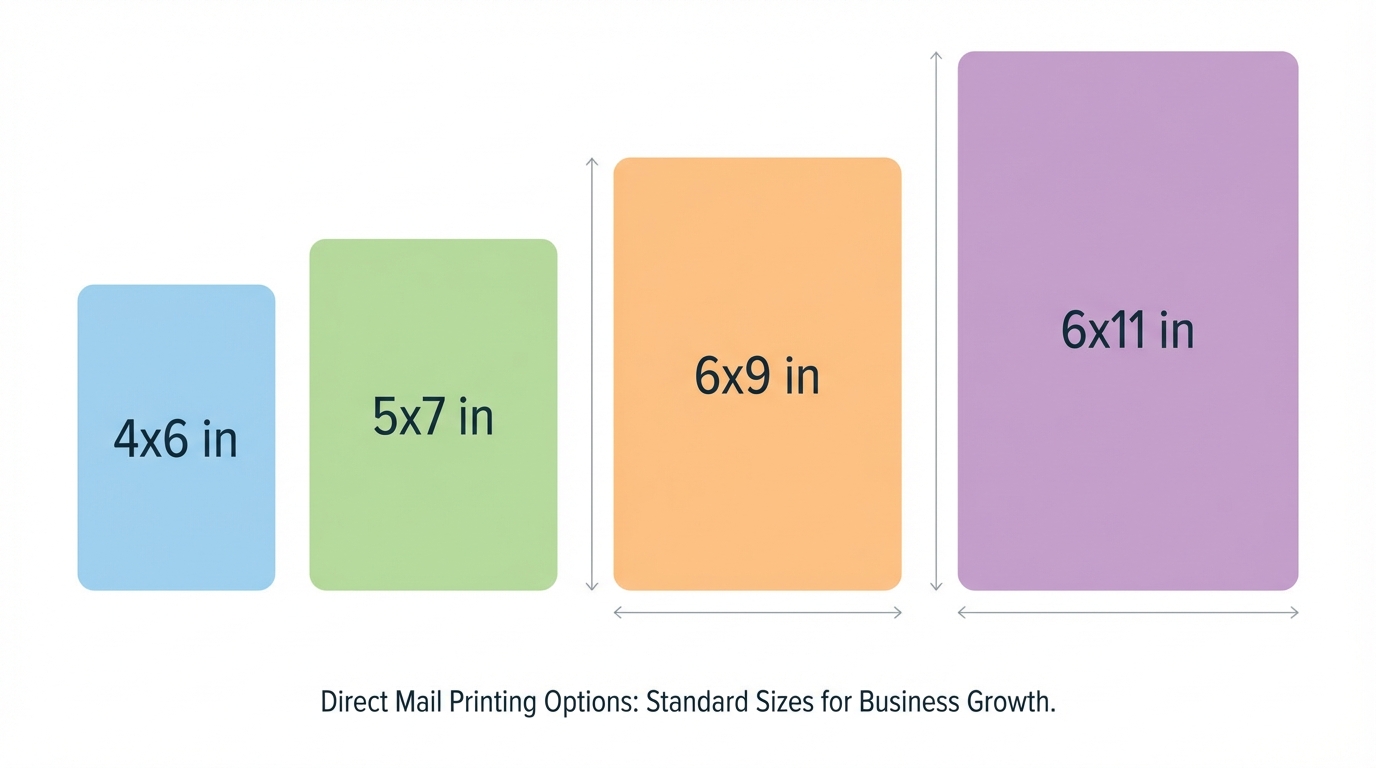
Within Marketing Mail, a 4x6 card and a 6x11 jumbo card both mail at the Marketing Mail letter rate of $0.467 per piece. Postage does not increase with size across that range. Only the printing cost changes, and the difference between a 4x6 and a 6x11 is a few cents per piece.
First-Class behaves differently. A card at 4.25x6 or smaller qualifies for the First-Class Mail postcard rate of $0.495 per piece. Go larger and the same job mails at the First-Class Mail letter rate of $0.707 per piece.
The practical takeaway: on Marketing Mail, mailing small to save postage does not work. You are giving up more than half the available real estate for no postal saving at all.
First-Class or Marketing Mail
| Factor | First-Class Mail | Marketing Mail |
|---|---|---|
| Presorted letter rate (Mixed) | $0.707/pc | $0.467/pc |
| Typical in-home time | 1 to 5 days | 5 to 21 days |
| Forwarding and return | Included | Not included |
| Minimum piece count | 500 | 200 |
| Best for | Time-sensitive, compliance, statements | Promotions, saturation, prospecting |
First-Class costs about $0.24 more per piece on letters and buys speed plus forwarding and return. On 10,000 pieces that is a $2,400 difference. Choose it when the mail date is tied to a deadline, when the piece contains regulated content, or when list accuracy matters enough that free forwarding pays for itself.
Marketing Mail is the default for promotional work. Nonprofit authorization drops the letter rate to $0.257 per piece at the Mixed tier, which is why qualifying organizations should always confirm their authorization before quoting.
EDDM or a Targeted List?
This is the first real fork in a campaign, and it changes the print spec as well as the postage.
Every Door Direct Mail saturates entire USPS carrier routes. There is no mailing list, no name on the piece, and no data processing cost. USPS postage is $0.260 per piece at the EDDM retail tier, and as with every rate on this page that is the postal figure only, before printing and preparation. The tradeoff is that you mail every address on the route, including the ones that will never buy, and the piece must meet EDDM size rules rather than standard letter dimensions.
A targeted list costs more per piece and reaches fewer households, but every piece is aimed. You can filter by income, homeownership, business type, credit signals, or new movers, and you can personalize each piece with variable data. USPS postage runs at the Marketing Mail letter rate of $0.467 per piece at the Mixed tier for a standard card or letter, again before print and list costs.
The decision usually comes down to density. If your customers are geographically concentrated and your offer has broad appeal, such as a restaurant, dental practice, or home services business, EDDM typically wins on cost per acquisition. If your buyer is a narrow slice of the population, such as a specific business type or an income band, paying for the list is cheaper than paying postage on everyone who does not qualify.
Our EDDM services page covers route selection and size rules in detail, and we quote both approaches side by side when the answer is not obvious.
▶ Get EDDM pricing for your area - Learn more about our eddm mailing services
Formats We Print and Mail
Postcards remain the highest volume format because they need no envelope, no insertion, and no folding. See our postcard printing options for sizes, stocks, and coatings.
Beyond postcards, common formats include letter packages in #10 or 6x9 envelopes with variable data personalization, self-mailers and folded pieces with tabbing, statements and invoices with account-level variable data, booklets and catalogs, and newsletters. Specialty envelopes, live stamps, and hand-assembly work are available when a piece needs to look personal rather than produced.
Our commercial printing services page lists the full equipment and product range for print-only work.
Why Buyers Choose MPA Over Online-Only Printers
Online self-service printers compete well on a single line item: the cost to print a postcard. The comparison changes once mailing enters the picture.
One vendor owns the whole job. Data, print, finishing, and USPS induction happen on one job ticket in one facility. There is no file handoff between a printer and a separate mail house, which is where mail dates usually slip.
Presort and induction on our permit. We hold a USPS BMEU permit and enter mail directly. Customers do not need their own permit, and they do not pay retail postage.
Compliance is documented. MPA is SOC 2 Type 2 audited and HIPAA compliant, with chain of custody documentation. Healthcare, insurance, and government mailers need that on file before a job starts.
Real production capacity with no minimums. We run jobs from a few hundred pieces to full saturation campaigns. Short runs do not carry the plate and makeready charges that inflate small offset orders.
A person answers. Every job has a project manager who owns it from data receipt through mail date.
For the mailing side in depth, see our mailing services hub, and for list work see data services.
Tracking, Reporting, and Proof of Delivery
The Intelligent Mail barcode applied during addressing is not just an automation requirement. It generates scan events as pieces move through the postal network, which is what turns a mail drop into something you can report on.
Every job includes the postage statement and the mailing manifest. On request we add IMb scan reporting, so you can see when the mailing entered the stream and roughly when it began landing. That matters most when a mailing is timed to an event, an enrollment window, or a follow-up call block.
For response attribution, the two mechanisms that work reliably are a unique landing page or QR code per campaign, and a dedicated phone number. Both let you tie replies back to a specific drop rather than guessing. USPS Informed Delivery can also place a digital preview of the piece in recipients' daily email, which gives the campaign a second impression at no added postage.
On response expectations, the ANA Response Rate Report puts direct mail at roughly a 9% average response rate for house lists and about 5% for prospect lists. Treat those as directional benchmarks rather than forecasts. The variables that actually move a campaign are list quality, offer strength, and timing, in that order.
Industries We Print and Mail For
Regulated and deadline-driven mail is the majority of what moves through the plant. Healthcare payers and practices send patient communications, explanation of benefits, and appointment recall under HIPAA. Insurance carriers run enrollment and annual notification mail against fixed regulatory windows.
Government agencies, including Florida state agencies under our state contract, send public notices, hearing notifications, and utility billing. Nonprofits mail appeals and newsletters at the nonprofit authorized rate. Financial services, property management, home services, real estate, and retail round out the recurring work.
What these have in common is a fixed date and a documentation requirement, which is why they tend to run on recurring schedules rather than one-off drops.
Turnaround Times
| Job type | Production time after proof approval |
|---|---|
| Postcards, First-Class | 3 to 5 business days |
| Postcards, Marketing Mail | 5 to 7 business days |
| Letter packages with inserting | 5 to 7 business days |
| EDDM | 3 to 5 business days |
| Statements and recurring data jobs | 2 to 3 business days |
These are production times, measured from proof approval. In-home delivery time is added on top and depends on the mail class. Data hygiene adds one business day when the list needs it.
What to Send Us
Files that arrive correctly the first time save two to three days. Send print-ready PDFs at 300 DPI in CMYK, with 0.125 inch bleed on all sides and live text kept 0.25 inch inside the trim. Keep the address panel clear on any self-mailer or postcard, since the barcode area cannot carry artwork.
Lists should arrive as CSV or Excel with one column per field. Separate columns for first name, last name, company, address line 1, address line 2, city, state, and ZIP. Combined single-field addresses have to be parsed before processing, which adds time.
Not sure whether a file is press-ready? Run it through our free file check tool before sending.
Working backward from the mail date
If the campaign has a date attached, build the schedule in reverse. Start from the day the piece needs to be in the mailbox, subtract in-home delivery time for the mail class, then subtract production time, then add a day for data hygiene and a day or two for proof approval.
For a Marketing Mail postcard that needs to land on the first of the month, that means files and list in hand roughly three weeks ahead. First-Class compresses the delivery window and pulls the deadline in by about a week. Campaigns tied to enrollment periods, event dates, or seasonal windows should build in a few extra days, because those are exactly the weeks when postal volume peaks.
Send the target in-home date with the quote request and we will tell you the file deadline that supports it.
Frequently Asked Questions About Direct Mail Printing Services
What are direct mail printing services?
Direct mail printing services combine commercial printing with USPS mail preparation. A provider prints the piece, standardizes and validates the mailing addresses, applies addressing and an Intelligent Mail barcode, presorts the mail to earn automation discounts, and inducts it into the postal system under a permit. Print-only vendors stop after the printing step.
How much do direct mail printing services cost?
Cost is print plus postage, quoted separately. Printing runs about $0.16 per piece for a 4x6 postcard at 1,000 pieces and about $0.08 per piece at 25,000 pieces; a letter package runs about $0.42 per piece at 1,000 and about $0.20 per piece at 25,000. Postage is added at the USPS rate the finished piece qualifies for, such as $0.467 per piece for a Marketing Mail letter at the Mixed tier. Data processing, addressing, and lettershop are quoted as a separate line.
Do I need my own USPS permit?
No. We mail under our permit and apply the indicia in house, so you do not need to open or maintain a permit account. Customers who already hold a permit can mail under their own if they prefer.
What is the minimum quantity?
Marketing Mail requires 200 pieces or 50 pounds to presort, and First-Class presort requires 500 pieces. We print smaller quantities than that, but below those thresholds the mail goes out at retail postage rates.
Can you print and mail if I only have a customer list and no design?
Yes, on request. Most customers send a print-ready PDF, or start from a free template on the design templates hub and run it through the free file check first. If you need help getting the file ready, mention it when you request a quote and we will scope it with the job.
How long does a direct mail campaign take?
Production runs 3 to 5 business days for First-Class postcards and 5 to 7 business days for Marketing Mail after proof approval. Add in-home delivery time on top, which is 1 to 5 days for First-Class and 5 to 21 days for Marketing Mail.
Do you handle HIPAA-regulated mail?
Yes. MPA is HIPAA compliant and SOC 2 Type 2 audited, with documented chain of custody. Healthcare payers, practices, and insurance carriers use us for patient communications, explanation of benefits, and enrollment mailings.
Can you mail to all 50 states?
Yes. We serve businesses in all 50 states from a single Lakeland facility, and mail is inducted in Lakeland and entered into the national postal network.
Get a Direct Mail Printing Quote
Send the quantity, the format, the mail class you have in mind, and the list size. If any of those are still open, send what you have and we will price the options side by side.
Request a quote or call 863-687-6945.
"The single most-overlooked variable in direct-mail performance isn't creative or list quality. It's USPS handoff timing. Get that wrong and your response window collapses by two weeks."
Alec Boye, President, Mail Processing Associates