EDDM Mailing Requirements: 2026 The Complete Guide to USPS Indicia, Sizes, and Specifications
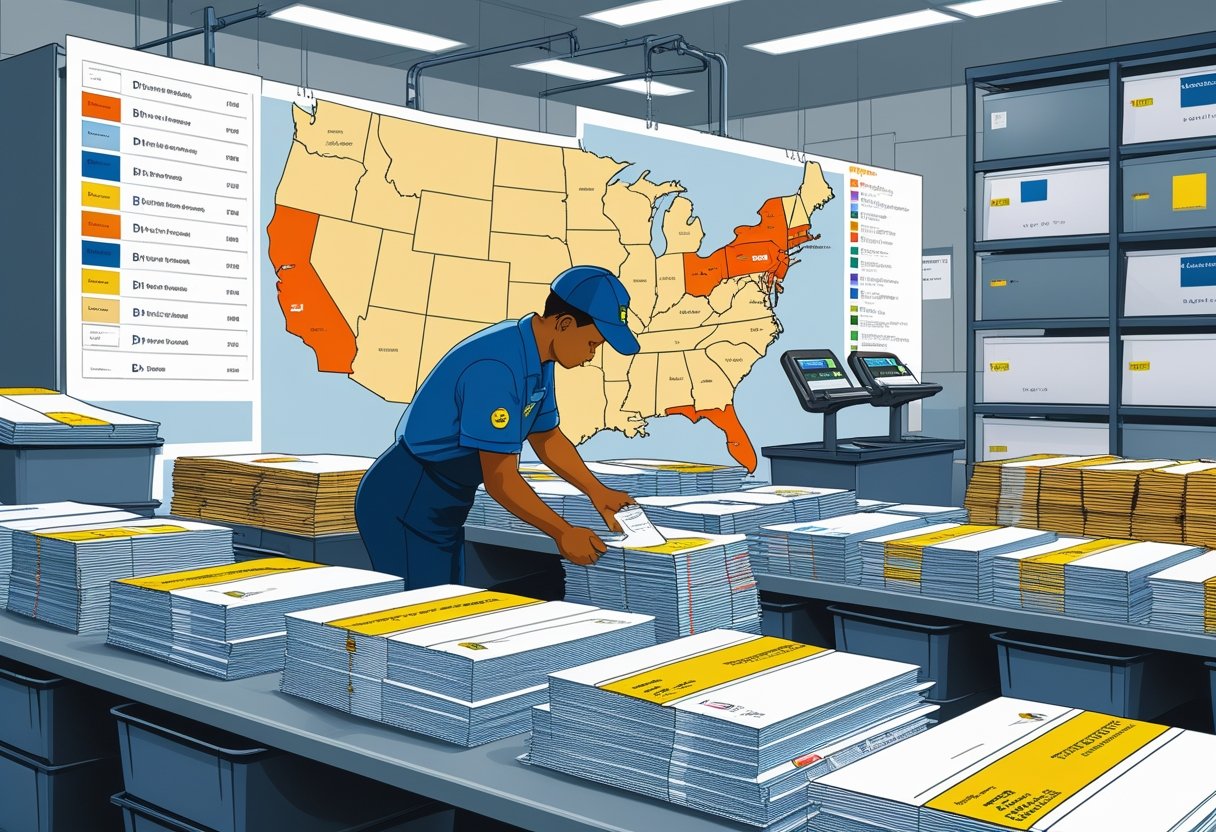
Every Door Direct Mail (EDDM) puts your marketing materials into every mailbox on a carrier route - no mailing list required. But USPS enforces strict EDDM mailing requirements on size, weight, indicia placement, and bundling. Miss one detail and your entire mailing gets rejected at the counter.
This guide covers every EDDM specification you need to know in 2026, from EDDM indicia requirements to postage permit rules. Whether you are preparing your first EDDM campaign or your fiftieth, use this as your pre-flight checklist.
Need a turnkey EDDM campaign? Get a free quote from MPA - we handle prepress, printing, and postal prep so you can focus on results.
Pick your EDDM routes on a live map
See household counts, resident demographics, and exact per-piece pricing for any neighborhood. No account needed.
Open the free route plannerWhat Are the EDDM Mailing Requirements?
EDDM mailpieces must qualify as USPS flats: each piece must exceed either 6.125 inches in height or 10.5 inches in length, stay within 12 x 15 inches, and weigh under 3.3 ounces. Every piece needs a printed EDDM indicia in the upper-right corner (including "ECRWSS") and a generic address block reading "LOCAL POSTAL CUSTOMER" instead of a name. Pieces are bundled in groups of 50 or 100 with a facing slip on each bundle, and you file PS Form 3587 for EDDM Retail (capped at 5,000 pieces per ZIP code per day) or PS Form 3602 for EDDM BMEU.
Planning an EDDM drop? Pick routes and see live pricing yourself, or have our team quote it for you.
Prefer a managed EDDM quote? Send your details and we will reply with pricing. No obligation.
No obligation, or call (863) 687-6945. One quote covers print, postage, and mail prep.
What Is EDDM and Why Do Requirements Matter?
Every Door Direct Mail is a USPS program that lets businesses send flat mailpieces to every address on selected postal carrier routes. Instead of purchasing or building a mailing list, you choose ZIP codes and routes based on demographic data - household income, age ranges, household size - and USPS delivers to every door on those routes.
The trade-off for that simplicity is strict adherence to EDDM guidelines set by USPS. Your mailpieces must meet exact EDDM mailer requirements for size thresholds, display a compliant EDDM indicia, follow specific bundling rules, and use the correct addressing format. Fail any of these EDDM mailing requirements and your post office will reject the mailing outright.
For a full overview of EDDM strategy and planning, see our complete EDDM guide.
EDDM Indicia Requirements
The EDDM indicia is the printed postage marking that replaces a traditional stamp or meter imprint. Understanding EDDM indicia requirements is critical because USPS requires this marking on every EDDM mailpiece, and the formatting rules are exact.
What the EDDM Indicia Must Include
The EDDM Retail indicia must contain all of the following text elements:
- "ECRWSS" (Enhanced Carrier Route Walking Sequence Saturation) - this code identifies the mailing as saturation mail
- "EDDM" on its own line
- "U.S. POSTAGE PAID" in all capitals
- Your city and state (the mailing origin)
- "PERMIT NO." followed by your permit number (for EDDM BMEU only)
For EDDM Retail (no permit required), the indicia reads:
ECRWSS
EDDM
U.S. POSTAGE PAID
LAKELAND, FL
For EDDM BMEU (permit required), it includes the permit number:
ECRWSS
U.S. POSTAGE PAID
LAKELAND, FL
PERMIT NO. 123
Indicia Placement and Size Specifications
USPS dictates exactly where and how the EDDM indicia must appear:
- Location: Upper-right corner of the address side, within a rectangle measuring 1.625 inches from the right edge and 1.375 inches from the top edge
- Minimum font size: 4-point type, all caps. For readability, use 8-point or larger
- Typeface: Use a clean sans-serif font - Arial, Helvetica, or similar. Decorative or script fonts will get flagged
- Clearance: Leave at least 1/8 inch of clear space around the indicia borders (top and right edges)
- Printing method: The indicia must be printed directly on the mailpiece. Handwritten, stickered, stamped, or label-applied indicia are not accepted
If you are searching for an EDDM indicia PNG to use in your design files, download it directly from USPS.com or ask your print provider. At MPA, we include the correct indicia in every EDDM design template we produce.
Common EDDM Indicia Requirements Mistakes That Cause Rejections
These are the EDDM indicia requirements errors we see most often from first-time mailers:
- Missing "ECRWSS" - This code is non-negotiable. Without it, your piece is not identified as saturation mail
- Wrong placement - The indicia must be in the upper-right area. Placing it on the left side or bottom will cause rejection
- Too small to read - While the minimum is 4-point, anything under 8-point risks legibility complaints from postal clerks
- Using a stamp or sticker - The indicia must be printed as part of the mailpiece artwork
- Including a permit number on EDDM Retail - Retail mailings do not use permit numbers. Adding one creates confusion at the counter
EDDM Mailpiece Size Specifications
Beyond EDDM indicia requirements, size is the next most common failure point. EDDM pieces must qualify as USPS "flats" - larger than standard letters. This minimum size requirement is what triggers the EDDM processing category.
Minimum and Maximum Dimensions
| Specification | Minimum | Maximum |
|---|---|---|
| Height | 6.125 inches | 12 inches |
| Length | 10.5 inches | 15 inches |
| Thickness | 0.009 inches (0.25 mm) | 0.75 inches |
| Weight | -- | 3.3 ounces |
Source: USPS Every Door Direct Mail (usps.com)
The critical rule: Your mailpiece must exceed at least one of these two thresholds - either 6.125 inches in height OR 10.5 inches in length. Standard 4x6 postcards do not qualify. Standard 6x9 postcards do not qualify either, because 6 inches is under the 6.125-inch minimum and 9 inches is under 10.5 inches.
Most Popular EDDM Postcard Sizes
Based on the campaigns we produce at MPA, these are the most common EDDM specifications for postcard sizes:
- 6.25 x 9 - The minimum practical size. Meets the height threshold (6.5 > 6.125). Economical on paper and postage
- 8.5 x 11 - Letter-size flat. Plenty of room for maps, coupons, menus, and detailed offers
- 9 x 12 - Maximum impact without going oversized. Popular for real estate, political campaigns, and restaurant menus
- 11 x 17 (folded) - Bi-fold to 8.5 x 11, giving you four panels of content
For a deeper look at which sizes perform best, read our EDDM postcard design tips.
Printing thousands of EDDM pieces? Talk to our production team about volume pricing on any EDDM size.
Paper Weight and Thickness Rules
EDDM pieces must be at least 0.009 inches thick. In practice, this means:
- 80 lb. gloss cover - Meets the minimum at roughly 0.010 inches. This is the most common stock for EDDM postcards
- 100 lb. gloss cover - About 0.012 inches. Feels more substantial in hand
- 14 pt. cardstock - Industry standard for postcards at 0.014 inches. Sturdy, professional feel
- Text-weight paper (60-80 lb. text) - Does NOT meet the 0.009-inch minimum on its own. Must be folded or used in a multi-panel format to reach minimum thickness
EDDM Addressing and Recipient Requirements
EDDM mailpieces do not carry individual recipient names or addresses. Instead, they use a generic addressing block.
Required Address Format
Every EDDM piece must include this exact addressing:
LOCAL POSTAL CUSTOMER
Or alternatively:
RESIDENTIAL CUSTOMER
This address block goes in the lower-right portion of the address side, below and to the left of the indicia. The address must be printed - not handwritten or labeled.
You do not include street addresses, names, or ZIP codes on the individual pieces. The carrier route identification is handled through facing slips on each bundle, not on the mailpieces themselves.
What You Cannot Include
- Individual recipient names or addresses
- Barcodes (IMBs are not used for EDDM)
- Return address (optional but not required)
See live EDDM pricing for any ZIP in 60 seconds.
Plan Your Map →EDDM Permit vs. No Permit: Retail and BMEU Explained
USPS offers two EDDM entry methods, and the EDDM permit requirements differ between them.
EDDM Retail (No Permit Required)
EDDM Retail is the simpler option, designed for small businesses running their own campaigns:
- No postage permit needed - Pay at the retail counter
- Maximum 5,000 pieces per day, per ZIP code - You can mail to multiple ZIP codes on the same day, but each ZIP is capped at 5,000
- Postage rate: $0.260 per piece (2026 rate)
- Drop-off: Your local post office retail counter
- Payment: Cash, check, debit, or credit at the counter. You can also pay online through the USPS EDDM portal
EDDM Retail works well for campaigns under 5,000 pieces. For anything larger, BMEU is the better path.
EDDM BMEU (Permit Required)
Business Mail Entry Unit (BMEU) is the commercial-grade EDDM option:
- Requires a USPS mailing permit - Apply using PS Form 3615 at your local BMEU
- No daily piece limit - Mail tens of thousands of pieces in a single drop
- Postage rate: $0.259 per piece (2026 rate) - a half-cent savings over Retail
- Drop-off: Business Mail Entry Unit (not the retail counter)
- Payment: Permit imprint, USPS commercial account, or precanceled stamps
The Retail-to-BMEU rate gap is now a tenth of a cent per piece, so the real reason to use BMEU entry is operational: no 5,000-piece daily cap per ZIP, and commercial induction that scales to any drop size.
For comparison, a First-Class postcard stamp costs $0.65 per piece - more than double the EDDM rate. Learn more about EDDM cost breakdowns.
How to Get an EDDM Permit
- Visit your local BMEU (not the retail counter)
- Complete PS Form 3615 (Application for Mailing Permit)
- Pay the annual permit fee (currently $265 for a permit imprint)
- Receive your permit number
- Include the permit number in your EDDM BMEU indicia
The permit renews annually. If you mail frequently, the savings over Retail postage will pay for the EDDM permit within a few campaigns.
Want to skip the permit process entirely? Work with MPA and mail under our existing permits. No application, no annual fee, no hassle.
Bundling and Preparation Requirements
Bundling is another critical area of EDDM mailing requirements. How you bundle and label your EDDM mail is just as important as the mailpiece design itself. Incorrect preparation is one of the top reasons EDDM jobs get turned away at the post office.
Bundle Size Rules
- Maximum 100 pieces per bundle for pieces that are 0.25 inches thick or less
- Maximum 50 pieces per bundle for thicker pieces
- Bundles must be secured with rubber bands or shrink wrap
- All pieces in a bundle must face the same direction, indicia side up
Facing Slip Requirements
Each bundle needs a facing slip - a small card placed on top of the first piece in the bundle. The facing slip must include:
- Carrier route number (e.g., C001, C005)
- Number of pieces in the bundle
- Mailer's name or business name
- Date of mailing
USPS provides facing slip templates, or your mail preparation software can generate them. At MPA, we produce facing slips automatically as part of our EDDM production workflow.
Traying and Sacking
EDDM flats are typically placed in USPS flat trays (Eastern or Western region trays, depending on your location). Each tray is labeled with the destination post office and route information.
For large-volume BMEU mailings, you may also use sacks. Your BMEU will provide specific instructions based on the volume and destination spread of your mailing.
EDDM Documentation: Forms and Paperwork
PS Form 3587 (EDDM Retail)
For EDDM Retail mailings, you must complete PS Form 3587 for each mailing. This form includes:
- Your name and business information
- Mailing date
- Number of pieces per route
- Total pieces in the mailing
- Payment amount
You can fill this out online through the USPS EDDM web tool (eddm.usps.com) or use a paper form at the post office.
PS Form 3602 (EDDM BMEU)
BMEU mailings use PS Form 3602 (Postage Statement) instead. This is a more detailed document that includes:
- Permit information
- Mail class and rate category
- Total postage calculation
- Processing category
- Weight per piece
USPS EDDM Online Portal
The USPS EDDM portal (eddm.usps.com) is the easiest way to handle EDDM Retail paperwork. Through the portal, you can:
- Select carrier routes using an interactive map
- View demographic data for each route (household count, age, income)
- Calculate total postage
- Complete and submit PS Form 3587 online
- Pay postage with a credit card
For a hands-on walkthrough of route selection, try our EDDM planner tool. Want the full price before you commit? Use our EDDM cost calculator to see postage, printing, and prep costs together.
Overwhelmed by the paperwork? Let MPA handle every EDDM requirement - from form completion to postal drop-off.
EDDM Design Guidelines for Print-Ready Files
Meeting EDDM specifications goes beyond just hitting the size minimums and EDDM indicia requirements. Your design files need to be print-ready and postal-compliant.
Address Side Layout Rules
The address side of your EDDM piece has a specific layout that USPS requires:
- Indicia: Upper-right corner (see indicia requirements above)
- Address block: "LOCAL POSTAL CUSTOMER" in the lower-right half
- Return address (optional): Upper-left corner if included
- Clear zone: Keep the lower-right 4.5 x 2.75 inch area relatively clean for postal processing
The non-address side has no USPS layout restrictions. Use it for your primary marketing message, images, offers, and calls to action.
File Preparation Specs
For print-ready EDDM files, follow these technical EDDM specifications:
- Resolution: 300 DPI minimum (images at 300 DPI, vector elements preferred)
- Color mode: CMYK (not RGB)
- Bleed: 0.125 inches on all four sides
- Safe zone: Keep critical text and logos at least 0.25 inches from trim edge
- File format: PDF/X-1a or press-quality PDF
At MPA, we run every EDDM file through preflight checks on our Xerox Iridesse and Versant production presses before printing. If your file has issues, we catch them before they become expensive problems.
Want us to handle sizing, prep, and drop-off end to end?
Get a Quote →EDDM vs. Standard Direct Mail: When to Use Each
EDDM is powerful but not always the right tool. Here is a quick comparison:
| Factor | EDDM | Standard Direct Mail |
|---|---|---|
| Targeting | Every address on a route | Individual addresses from a mailing list |
| Postage (2026) | $0.26 to $0.31/piece | $0.395-$0.65/piece depending on class |
| Minimum size | 6.125 x 10.5 (flat) | 3.5 x 5 (postcard) or letter |
| Personalization | None (generic addressing) | Full variable data (name, address, custom offers) |
| Permit required | No (Retail) / Yes (BMEU) | Yes |
| Best for | Local saturation, new market entry | Targeted campaigns, existing customer lists |
Use EDDM when you want blanket coverage of a geographic area. Use standard direct mail when you have a curated list and want personalized messaging. Many businesses use both - EDDM for awareness and standard mail for follow-up.
Learn more about EDDM services from MPA.
Common EDDM Rejection Reasons and How to Avoid Them
Even when you understand every EDDM specification on paper, execution mistakes happen. After processing thousands of EDDM jobs, these are the rejection reasons we encounter most frequently:
1. Mailpiece Does Not Meet Minimum Size
Your piece must exceed 6.125 inches in height OR 10.5 inches in length. A 6x9 postcard fails both thresholds. Always verify measurements against the minimums before printing.
2. Indicia Missing or Incorrectly Formatted
This is the most common EDDM indicia requirements violation. The EDDM indicia must include all required text elements, be printed (not applied), and sit in the upper-right corner. Double-check every element against the EDDM indicia requirements listed above.
3. Exceeding the 5,000-Piece Retail Cap
EDDM Retail limits you to 5,000 pieces per ZIP code per day. If your campaign is larger, you need BMEU entry or must split across multiple days.
4. Missing or Incorrect Facing Slips
Every bundle needs a facing slip with the correct route number, piece count, and mailing date. Missing slips will halt your entire drop-off.
5. Improper Bundling
Bundles over 100 pieces (or 50 for thick stock) will be rejected. Loose bundles without rubber bands or shrink wrap will also be turned away.
6. Wrong Address Format
The address block must read "LOCAL POSTAL CUSTOMER" or "RESIDENTIAL CUSTOMER" - not an actual name or street address.
7. Weight Over 3.3 Ounces
Thick cardstock with heavy UV coating can push your piece over the weight limit. Weigh a finished sample before committing to a full print run.
EDDM Mailing Requirements Checklist
Use this EDDM mailing requirements checklist before every campaign:
Mailpiece Design:
- Dimensions exceed 6.125" height OR 10.5" length
- Dimensions do not exceed 12" x 15" x 0.75"
- Weight is under 3.3 ounces
- Paper thickness is at least 0.009 inches
- EDDM indicia is in the upper-right corner with all required text
- "LOCAL POSTAL CUSTOMER" address block is on the address side
- Files are 300 DPI, CMYK, with 0.125" bleed
Preparation:
- Pieces bundled in groups of 50 or 100 (per thickness)
- Bundles secured with rubber bands or shrink wrap
- Facing slips on each bundle with route number and piece count
- PS Form 3587 (Retail) or PS Form 3602 (BMEU) completed
Postage:
- EDDM Retail: Under 5,000 pieces per ZIP per day
- EDDM BMEU: Permit number on file and included in indicia
- Payment method confirmed (counter pay, online, or permit account)
Frequently Asked Questions
What are the exact EDDM indicia requirements for 2026?
The 2026 EDDM indicia requirements have not changed from 2025. The EDDM indicia must include "ECRWSS," "EDDM" (Retail only), "U.S. POSTAGE PAID," and your city/state. It must be printed directly on the piece in at least 4-point type (8-point recommended) using a sans-serif font.
Place it in the upper-right corner within 1.625 inches from the right edge and 1.375 inches from the top edge. BMEU indicia adds your permit number.
Where can I download an EDDM indicia PNG for my design software?
Yes, you can find EDDM indicia PNG files for download. USPS provides downloadable EDDM indicia templates on their website. You can also get compliant EDDM indicia PNG files through your print provider.
Make sure any downloaded EDDM indicia PNG matches the current USPS EDDM indicia requirements. The text content and placement rules have not changed for 2026, but always verify against the Domestic Mail Manual (DMM).
What is the minimum postcard size for EDDM?
Your mailpiece must exceed either 6.125 inches in height OR 10.5 inches in length. The most common minimum-size EDDM postcard is 6.25 x 9 inches. Standard 4x6 and 6x9 postcards do not qualify because they fall below both thresholds.
Do I need a permit for EDDM mailings?
For EDDM Retail, no EDDM permit is needed. You pay postage at the counter or online. For EDDM BMEU (mailings over 5,000 pieces or for commercial mailers wanting a lower rate), you need a USPS mailing permit obtained through PS Form 3615. The annual permit fee is $265 for permit imprint mailings.
How much does EDDM postage cost in 2026?
EDDM Retail postage is $0.260 per piece. EDDM BMEU postage is $0.259 per piece. Compare that to $0.65 for a First-Class postcard stamp. On a 5,000-piece campaign, EDDM saves over $1,500 compared to First-Class rates.
What goes in the address area on an EDDM mailpiece?
Instead of a recipient name and address, print "LOCAL POSTAL CUSTOMER" or "RESIDENTIAL CUSTOMER" in the address block area. No street address, ZIP code, or barcode is needed on the individual pieces. Carrier route information is handled through facing slips attached to each bundle.
Can I send EDDM mail to businesses, not just residences?
Yes. EDDM delivers to every active delivery point on a carrier route, which includes both residential and business addresses. You cannot selectively exclude businesses or residences from a route - it is all or nothing per route. If a route has a mix of both, all addresses receive your mailpiece.
What is the maximum number of EDDM pieces I can mail at once?
EDDM Retail is capped at 5,000 pieces per ZIP code per day. You can mail to multiple ZIPs on the same day, each with its own 5,000-piece limit. EDDM BMEU has no per-day cap - you can drop tens of thousands of pieces in a single submission as long as your postage account covers it.
Mail Processing Associates is a veteran-owned print and mail production facility in Lakeland, Florida. We have produced EDDM campaigns for restaurants, political candidates, real estate agents, nonprofits, and national brands for over 35 years. From design through postal delivery, our team handles every EDDM specification so your mail arrives on time and on budget.
Ready to launch your EDDM campaign? Contact MPA for a free quote or explore our EDDM planner tool to select your routes today.
"The single most-overlooked variable in direct-mail performance isn't creative or list quality. It's USPS handoff timing. Get that wrong and your response window collapses by two weeks."
Alec Boye, President, Mail Processing Associates